Written by Jesse Swirl
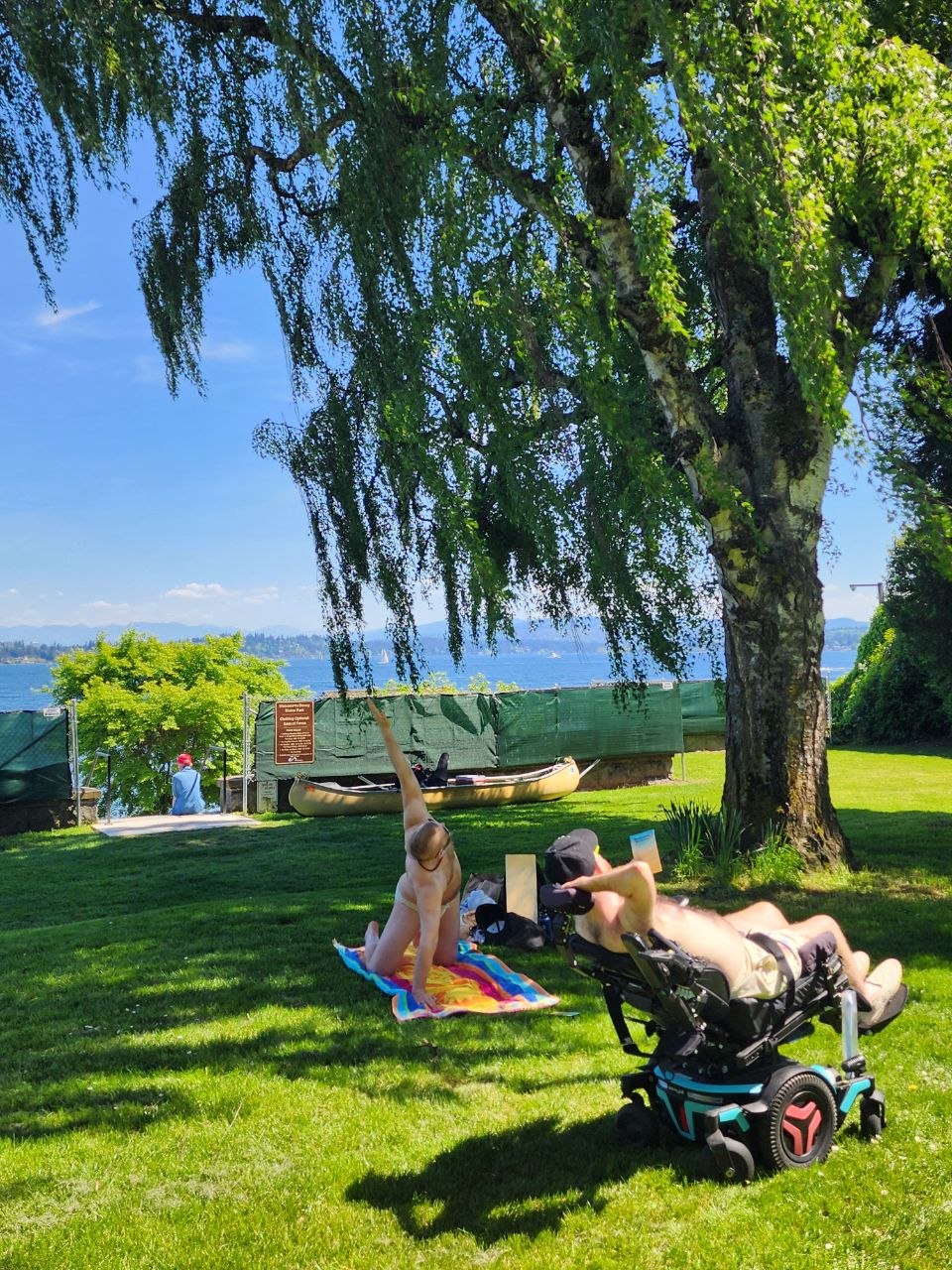
On the hottest day of the spring so far, I made my way to Denny Blaine and found the beach waking back up after months of gray skies and cold weather.
I stood on the upper level of the park looking down toward the beach below. Across the two lower levels, people sprawled across towels in the sun, waded into the water, and laughed as they caught each other up on the months apart. Others passed around notebooks filled with poetry they had written, reading lines aloud between bursts of conversation. Snippets of voices carried upward through the breeze drifting off the lake. Some people were reuniting for the first time since summer ended. Others only knew each other from this shoreline itself. They didn’t have each other’s phone numbers or social media. They simply recognized one another year after year as familiar faces returning with the sun.
Evan sat nearby in his wheelchair wearing nothing but shorts, smiling as the sunlight hit his skin. His boyfriend visiting from Portland lay stretched out on a blanket beside him, also soaking in the warmth.
Evan smiled.
“I have a spinal cord injury, so I can’t regulate my body temperature. I’m constantly cold,” he says. “When I can come out here and sit in the sun, it feels like my skin is alive. The rest of the year, I don’t feel that way.”
A warm breeze drifted across the hillside.
“I try to be as nude as possible in the sunlight,” Evan says with a soft laugh.
For Evan, places like this are about far more than nudity. They are about comfort. About existing in public without feeling watched or out of place.
“For me, it’s that I’m able to be nude and comfortable, enjoying my skin without feeling self-conscious about my posture or who’s looking or gawking,” he says. “The community here isn’t like that. It’s not overtly leery.”
He pauses for a moment before continuing.
“But also, being around bodies that don’t look like mine and knowing that everybody is able to enjoy being outside. There’s no other place that offers that.”
Before his spinal cord injury, spaces like this were easier to move through. Now every steep hill and uneven path shapes how he experiences public space. Places many people move through without thinking have become constant calculations about where he can go, where he can settle, and how fully he gets to participate in the life of the beach below.
Of the places he once spent time, Denny Blaine is the only one he can still access. But what keeps him returning is not just accessibility. It is the openness of the people gathered around it. People of different ages, backgrounds, body types, and identities sharing the same shoreline without much interest in judging one another. Some are queer, some are not, but many come here for the same reason: to exist a little more freely than they can elsewhere.
Evan told me he would like to see the beach become even more accessible for the community that has made this place home.
“I’d love to see a ramp,” he says. “It would benefit people bringing kayaks, scooters, bikes, anything. A rolling access would improve things.”
He describes accessibility not as something separate from the culture of the beach, but as part of the same openness and body positivity that has made the space meaningful to so many people for decades.
“It’s not just about wheelchair access. If this is a beach that celebrates different types of bodies, disability should be part of that.”
As conversations and laughter drifted upward from the shoreline below, Evan looked back toward the beach for a moment.
“It’s kind of emotional to talk about.”
His eyes began to water.
From where we sat, the lower beach almost felt like another room in the same house. Close enough to hear clearly, but separated in a way that changes how people experience the park.
Evan looks over at me and says, “It feels like we’re in the lobby while everyone else gets to go down.”
For many visitors, the slope down to the beach is something barely noticed. For Evan, it shapes the experience of being there. The way people move through the space, where the energy gathers, and how connected he feels to it all are shaped by terrain most people never have to think about.
And yet, even with that distance, he still comes back.
Not because it’s a nude beach, but because spaces like this have become increasingly rare. Places where different kinds of bodies exist openly alongside one another without much interest in judgment. Places where people return year after year not only for the sun, but for the feeling of being accepted there. For Evan, that feeling is deeply tied to the people who have built community around this shoreline over decades.
“It’s really healing socially to be around people who are comfortable and feel entitled to exist in public space in the same way,” he says. “Especially queer people.”

Leave a Reply